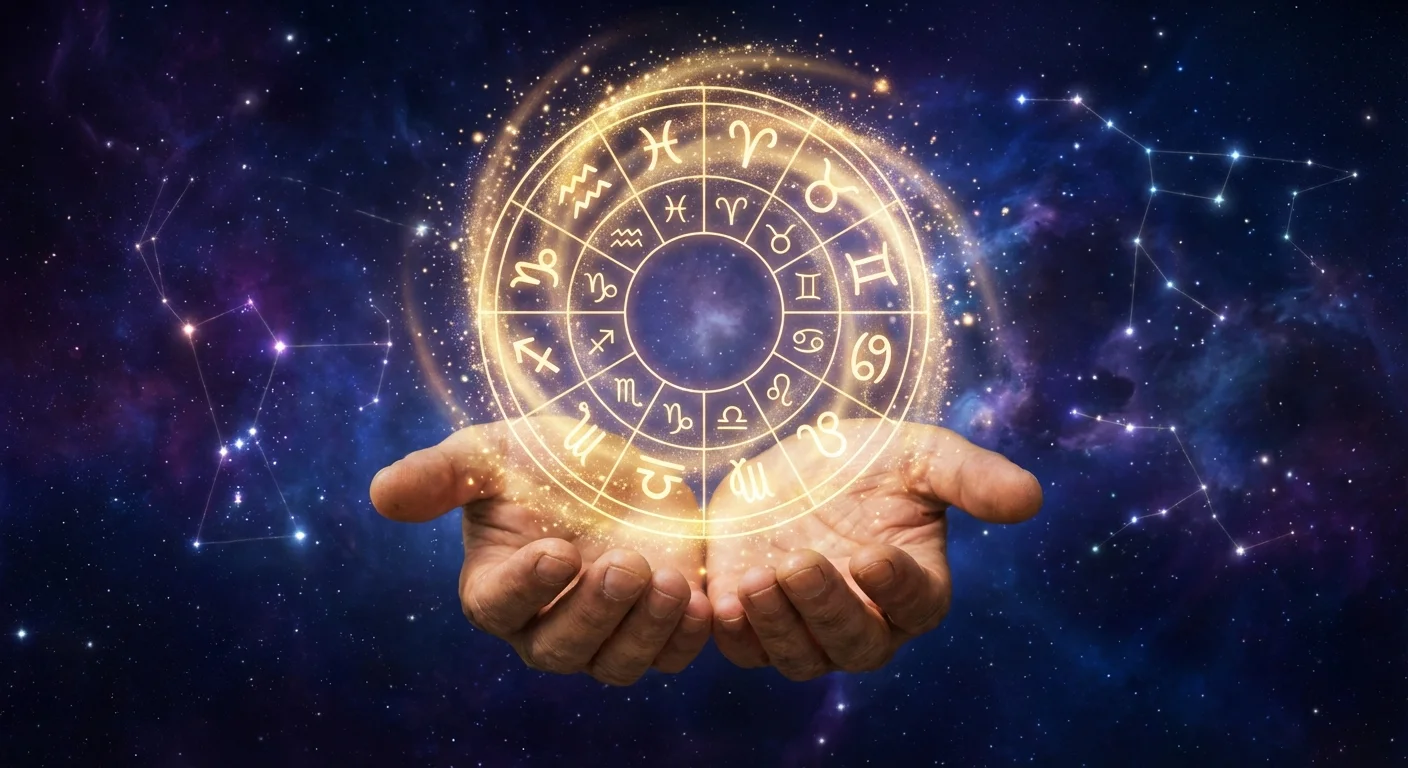
What Is a Natal Chart?

A natal chart—also called a birth chart—is a cosmic snapshot of the sky at the exact moment you were born. This celestial map reveals the positions of the Sun, Moon, planets, and other astronomical points, offering profound insights into your personality, potential, and life path.

Calculate Your Free Chart

🌌Understanding Your Cosmic Blueprint

Imagine the sky as a great clock, with the planets as its hands. At the moment of your first breath, this cosmic clock was frozen in a unique configuration that has never existed before and will never exist again. This is your natal chart—your personal cosmic fingerprint.

Unlike generic horoscopes that group billions of people by birth month, a natal chart is calculated for your specific birth date, time, and location. This precision creates a truly personalized map that reflects your individual nature with remarkable accuracy.

The practice of creating birth charts dates back thousands of years to ancient Mesopotamia, and has been refined through Hellenistic, Arabic, and modern Western traditions. Today, we can calculate planetary positions with astronomical precision, creating charts that would have astonished our ancestors.

The Building Blocks of Your Chart

Every natal chart is composed of the same core elements—planets, signs, houses, and aspects—but their unique arrangement creates a one-of-a-kind cosmic signature that belongs only to you.
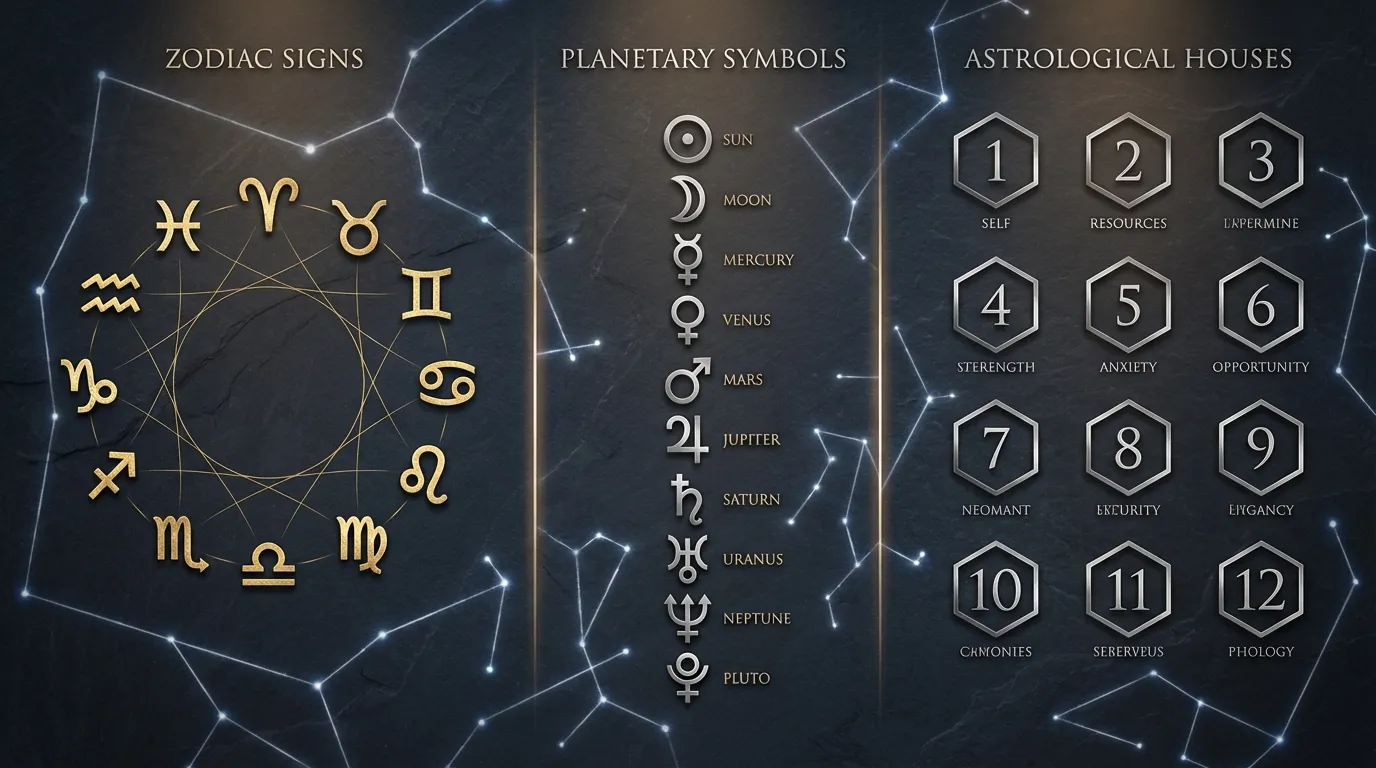
The 12 Zodiac Signs

The zodiac is the backdrop of your chart—12 constellations that the planets travel through. Each sign has unique qualities that color how a planet expresses itself.

Aries
Fire
Taurus
Earth
Gemini
Air
Cancer
Water
Leo
Fire
Virgo
Earth
Libra
Air
Scorpio
Water
Sagittarius
Fire
Capricorn
Earth
Aquarius
Air
Pisces
Water

The Planets

Planets represent different drives, needs, and functions of your psyche. Where they fall in your chart shows how these energies manifest in your life.

Sun
Core identity, ego, life force
Moon
Emotions, instincts, inner self
Mercury
Communication, thinking, learning
Venus
Love, beauty, values, pleasure
Mars
Action, desire, aggression, energy
Jupiter
Expansion, luck, wisdom, growth
Saturn
Structure, discipline, karma, time
Uranus
Innovation, rebellion, awakening
Neptune
Dreams, intuition, spirituality
Pluto
Transformation, power, rebirth

The 12 Houses

Houses represent different areas of life—from identity and values to relationships and career. Planets in a house focus their energy on that life domain.

1
Self & Identity
2
Values & Resources
3
Communication
4
Home & Roots
5
Creativity & Joy
6
Health & Service
7
Partnerships
8
Transformation
9
Philosophy & Travel
10
Career & Legacy
11
Community & Dreams
12
Unconscious & Spirituality

📖How to Read Your Natal Chart

Start with the Big Three

Your Sun sign represents your core identity—who you are at your essence. Your Moon sign reveals your emotional nature and inner needs. Your Ascendant (Rising sign) shows how you appear to others and approach new situations.

Explore the Houses

See which houses contain planets—these are your areas of focus in life. Empty houses aren't insignificant; they simply indicate areas that require less conscious attention. The sign on each house cusp colors how you approach that life area.

Study the Aspects

Aspects are angles between planets that show how different parts of your psyche interact. Trines (120°) and sextiles (60°) indicate harmony and natural talents. Squares (90°) and oppositions (180°) reveal tension that drives growth. Conjunctions (0°) fuse planetary energies together.

🧠The Jungian Approach to Astrology

Carl Jung, the founder of analytical psychology, was deeply interested in astrology. He wrote:

"Astrology represents the sum of all the psychological knowledge of antiquity."

— Carl Jung

At Celestia, we interpret your chart through a Jungian lens. This means we focus on:

  • Archetypes — The planets as universal patterns of the collective unconscious
  • Individuation — Your chart as a map toward psychological wholeness
  • Shadow Work — Challenging aspects as opportunities for integration
  • Synchronicity — Meaningful connections between celestial and psychological events

Frequently Asked Questions

How accurate are natal charts?
Natal charts are astronomically precise—the planetary positions are calculated using the Swiss Ephemeris, which is based on JPL ephemeris data from NASA. The Swiss Ephemeris is accurate to arc-seconds and is used by professional astrologers worldwide as the gold standard for planetary calculations. The interpretive accuracy depends on having your exact birth time. Planetary sign placements are accurate regardless of birth time, but house cusps and the Ascendant require a precise time—even a 15-minute difference can shift house cusps significantly. With the correct time, charts can reveal patterns that many find remarkably insightful for self-understanding. Celestia uses this precision to deliver psychologically grounded interpretations rather than generic forecasts.
Do I need my exact birth time?
For the most accurate chart, yes. Your birth time determines your Ascendant (Rising sign) and house placements, which are crucial for a complete reading. Even a 15-minute difference can shift house cusps. Hospitals in most countries record birth time on the birth certificate, though some countries and states are more consistent than others about this practice. Without a birth time, astrologers sometimes use a "solar chart" (set for noon or sunrise) to still gain meaningful insights. Your Sun, Moon, Mercury, Venus, and Mars positions are still accurate without a birth time, unless the Moon happens to be near a sign boundary on your birth day. If you don't know your exact time, check your birth certificate or ask family members. Celestia works with whatever information you have and clearly indicates which placements may be approximate.
What if I don't know my birth time?
You can still create a chart using noon as a default time. A "noon chart" gives accurate planetary sign placements for all planets except possibly the Moon if it's near a sign cusp on your birth day—the Moon moves about 12-13 degrees per day, so it can change signs within a single day. The Sun and outer planets (Jupiter through Pluto) move so slowly that they are accurate for the entire birth day regardless of time. Some astrologers use a technique called "chart rectification"—the process where an astrologer works backward from significant life events to estimate birth time with reasonable accuracy. This is a specialized skill requiring considerable expertise. In Celestia, you can proceed with a partial chart—all planetary sign placements are calculated and interpreted, with house positions marked as approximate.
Is astrology scientifically proven?
Astrology is not recognized as a science by the mainstream scientific community. The Shawn Carlson double-blind study (1985, published in Nature) tested astrology's validity and found no statistical support above chance for astrological predictions. However, this tests prediction accuracy, not symbolic or psychological utility—two very different standards. Carl Jung's concept of synchronicity offers a different framework for understanding astrology: not as a causal mechanism but as a system of meaningful correlations between inner and outer experience. Jung himself conducted extensive astrological research and wrote seriously about the subject. Our approach treats astrology as a symbolic language for understanding the psyche, drawing from Carl Jung's work on archetypes and the collective unconscious. Celestia presents astrology as a symbolic language for self-reflection, not prediction—a tool for psychological exploration, not determinism.
What's the difference between a natal chart and a horoscope?
A natal chart is a complete map of the sky at your exact birth moment—unique to you. A horoscope is a generalized prediction based only on your Sun sign, applying to everyone born in that month. Newspaper horoscopes effectively group one-twelfth of the world's population together—roughly 600 million people sharing the same "forecast." A natal chart, by contrast, contains 10 planets across 12 signs and 12 houses, creating thousands of unique combinations. Even two people born on the same day have different charts if born at different times or in different locations, because the Ascendant and house positions shift continuously. Natal charts are far more personal and detailed, considering all planets, houses, and their relationships. Your natal chart on Celestia is specific to your exact birth moment and location—not shared with anyone else born the same month.
How often should I read my natal chart?
Your natal chart never changes—it's a snapshot of your birth moment. However, you can revisit it as you grow and face different life stages. Transits—the current movements of planets through the sky—continuously activate different parts of the natal chart, so the same placements take on new relevance at different times of life. A Saturn transit over your natal Sun feels very different from a Jupiter transit over the same point: one demands discipline and accountability, the other brings expansion and opportunity. Many people revisit their chart during major life transitions—career changes, new relationships, losses, or relocations. Each return to the chart often reveals layers that weren't visible before. Many find new insights in familiar placements as they mature. Celestia's Transits feature shows you which natal chart areas are currently activated by planetary movements, giving you timely context for your chart.

Ready to Discover Your Cosmic Blueprint?

Create your free natal chart and receive AI-powered interpretations grounded in Jungian psychology.

Calculate Your Free Chart

We value your privacy

We use essential cookies for authentication and optional analytics cookies to improve our service. You can accept all cookies or customize your preferences.