Aspects in Astrology
Aspects are the angular relationships between planets in your chart. They reveal how different parts of your psyche interact—sometimes in harmony, sometimes in tension. Understanding aspects unlocks the dynamics of your cosmic blueprint.
See Your Aspects→
The Five Major Aspects
The primary relationships between planets
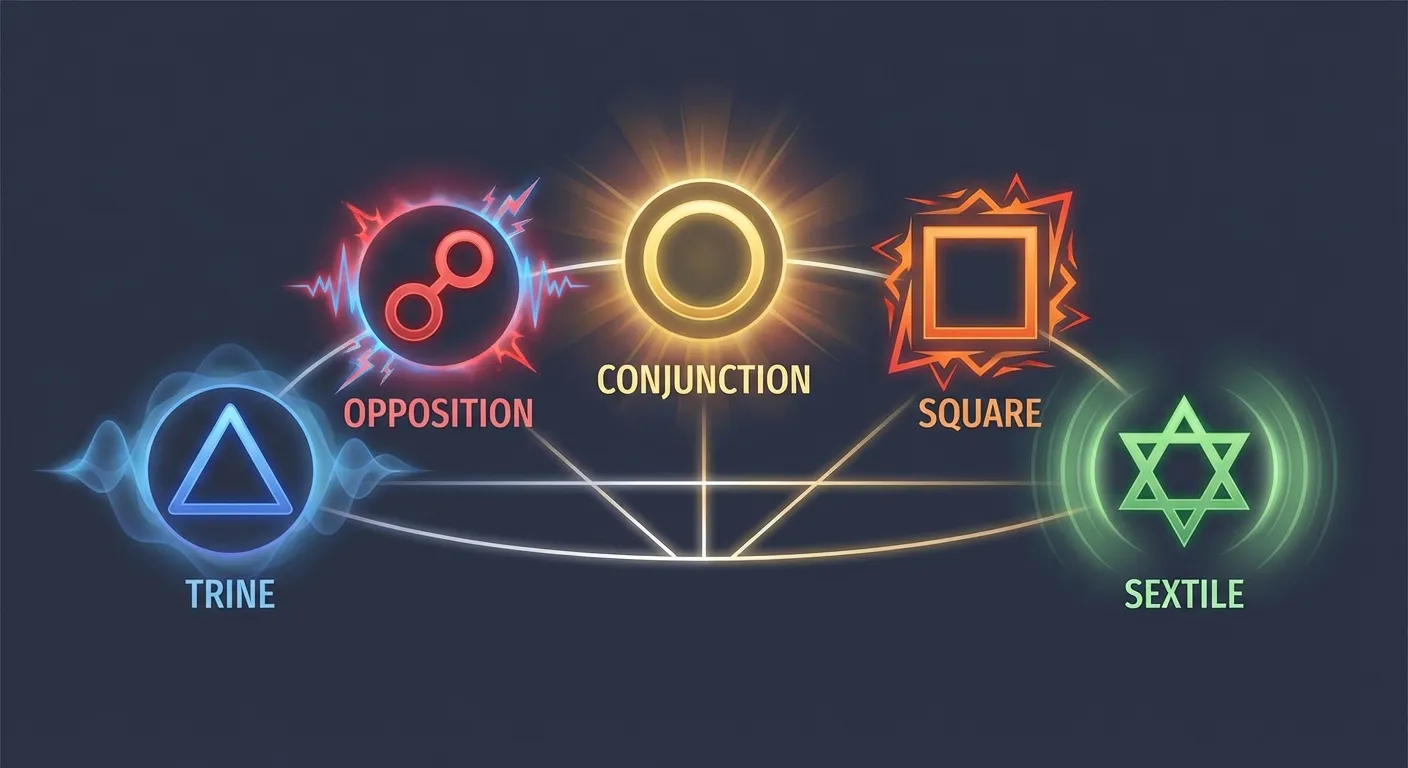
Major aspects form the backbone of chart interpretation. They're called "Ptolemaic aspects" after the ancient astrologer who codified them. These five configurations carry the most weight in any chart reading.
Conjunction
Merging • Intensity • Amplification • Unity
A conjunction occurs when two planets occupy the same degree (or very close). Their energies fuse and intensify each other. This can be harmonious or challenging depending on the planets involved.
Jungian Perspective: Conjunctions represent psychological complexes—energies that are bundled together and hard to separate. They indicate areas of concentrated focus and power, though sometimes difficulty in differentiating between the archetypes.
Opposition
Tension • Awareness • Projection • Balance
An opposition places two planets on opposite sides of the chart. This creates tension and a seesaw dynamic, but also awareness. Oppositions often manifest through relationships.
Jungian Perspective: Oppositions represent the classic psychological dynamic of projection—seeing in others what we fail to recognize in ourselves. Integration comes through owning both ends of the polarity.
Trine
Flow • Ease • Talent • Gifts
Trines connect planets 120° apart, usually in signs of the same element. Energy flows naturally between the planets, creating ease and natural talent in these areas.
Jungian Perspective: Trines represent innate abilities and psychological harmony. They can also indicate areas we take for granted or fail to develop because they come too easily.
Square
Challenge • Growth • Action • Crisis
Squares create 90° angles between planets, generating friction and tension. This aspect demands action and creates motivation through challenge. Squares are growth catalysts.
Jungian Perspective: Squares represent internal conflict—parts of the psyche that don't naturally cooperate. They create the tension that drives psychological development and individuation.
Sextile
Potential • Skill • Communication • Opening
Sextiles connect planets 60° apart, usually in compatible elements. They offer opportunities that require some effort to activate—doors that are open but not automatic.
Jungian Perspective: Sextiles represent areas of potential development that require conscious cultivation. Unlike trines, these gifts must be actively developed to manifest fully.
Minor Aspects
Subtle but significant planetary connections
Minor aspects add nuance and detail to chart interpretation. While less powerful than major aspects, they reveal subtle psychological dynamics and can be highly significant when they're tight or involve important planets.
Quincunx (Inconjunct)
Irritation • Adaptation • Health • Paradox
The quincunx connects planets with no natural affinity—different elements and modalities. It creates a persistent need for adjustment and can manifest as health issues or chronic irritation.
Quincunxes represent parts of the psyche that can't easily relate to each other. Resolution requires creative problem-solving and acceptance that some tensions remain productive paradoxes.
Semi-sextile
Friction • Annoyance • Growth Edge • Subtle
Semi-sextiles connect adjacent signs, which share neither element nor modality. This creates subtle, persistent friction—like a pebble in your shoe.
These aspects represent small but persistent psychological irritations that, when addressed, lead to refinement and growth.
Semi-square
Agitation • Inner Conflict • Drive • Restlessness
The semi-square creates internal friction similar to a square but more subtle. It generates agitation and restlessness that pushes toward change.
Semi-squares represent unconscious tensions that manifest as vague dissatisfaction or irritability, often requiring deeper self-reflection to identify.
Sesquiquadrate
Frustration • Karmic • Agitation • External Conflict
The sesquiquadrate (sesqui-square) creates tension similar to a square but often manifests more externally through circumstances and relationships.
This aspect represents karmic patterns that create friction with the external world, often pointing to lessons that need to be learned through experience.
Quintile
Talent • Creativity • Unique Gifts • Genius
Quintiles indicate creative gifts and unique talents. They show where you have the potential for original, inspired expression.
The quintile family represents specialized gifts that emerge from the individual unconscious—creative abilities that feel inspired or channeled from a deeper source.
Aspect Patterns
When multiple planets form geometric configurations
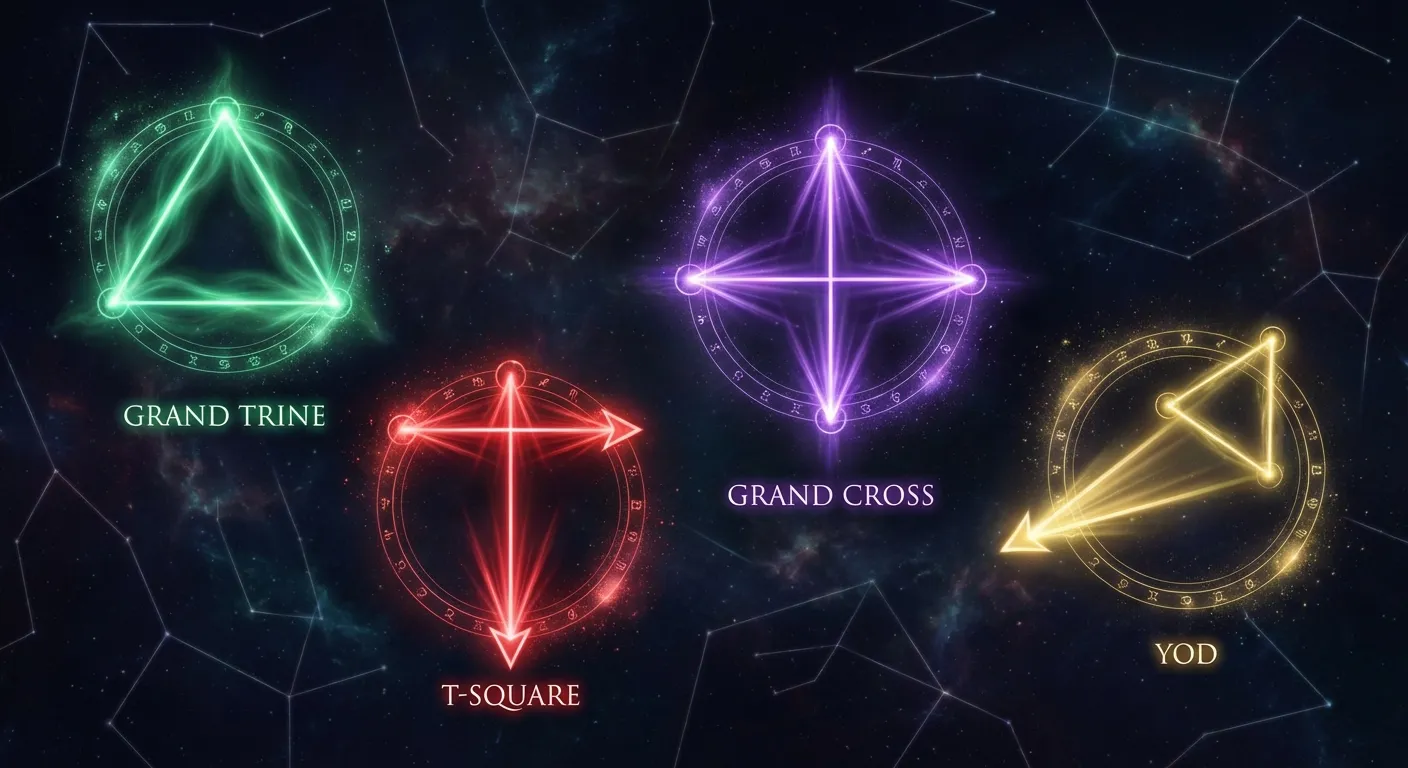
Aspect patterns occur when three or more planets link together through multiple aspects, creating geometric shapes in the chart. These configurations carry more significance than individual aspects and often point to core life themes.
Grand Trine
Three 120° trines forming a triangle
A Grand Trine forms when three planets create a perfect triangle in the chart, all in the same element (Fire, Earth, Air, or Water). This creates tremendous flow and natural talent in that element.
Interpretation: Grand Trines indicate areas of effortless ability but can also represent complacency. The easy flow can become a closed circuit unless a planet outside the pattern provides activation.
T-Square
Opposition + two squares
A T-Square forms when two planets oppose each other and both square a third planet (the focal planet). This creates significant tension that drives achievement.
Interpretation: The focal planet of a T-Square shows where tension is released and becomes the engine of accomplishment. People with T-Squares often achieve great things through the friction they create.
Grand Cross
Two oppositions + four squares
A Grand Cross (Grand Square) involves four planets at 90° intervals, creating two oppositions that cross each other. This is one of the most challenging configurations.
Interpretation: Grand Crosses create a sense of being pulled in four directions at once. Integration requires developing the center—finding inner stability amid external pressure.
Yod (Finger of God)
Two quincunxes + one sextile
A Yod forms when two planets sextile each other and both quincunx a third planet (the apex). This creates a sense of fate or special mission focused on the apex planet.
Interpretation: Yods are considered karmic patterns pointing toward a specific purpose. The apex planet represents a destiny that requires adjustment and conscious development.
Kite
Grand Trine + opposition
A Kite adds a fourth planet opposing one point of a Grand Trine and sextiling the other two. This gives the Grand Trine a focal point and outlet for its energy.
Interpretation: Kites take the natural talent of a Grand Trine and give it direction and purpose. The opposing planet provides motivation and a channel for expression.
Stellium
Multiple conjunctions
A Stellium occurs when three or more planets cluster in the same sign or house. This creates an intense concentration of energy in that area.
Interpretation: Stelliums focus tremendous energy on one life area or mode of expression. The person often feels drawn to express that sign or house theme strongly.
Understanding Orbs
How close is close enough?
An "orb" is the margin of error allowed for an aspect. A perfect trine is exactly 120°, but planets at 115° or 125° are still considered in trine—just with a wider orb.
Tight orbs (0-2°) create the strongest aspects. Wide orbs (5-8°) are still felt but with less intensity. Some astrologers use even wider orbs for aspects involving the Sun and Moon.
Key Principles
- •Tighter orbs = stronger influence
- •Luminaries (Sun/Moon) allow wider orbs
- •Applying aspects (approaching exact) are stronger
- •Different astrologers use different orb systems
Standard Orbs We Use
Frequently Asked Questions
Which aspects are most important?▼
Are "difficult" aspects actually bad?▼
What is an orb in astrology?▼
Can aspects change over time?▼
What if I have mostly harmonious aspects?▼
Do aspects between outer planets matter?▼
Discover Your Aspect Patterns
Create your free natal chart and see exactly how your planets interact through the language of aspects.
Calculate Your Free Chart→