The 12 Houses in Astrology
While planets represent drives and signs describe style, houses show WHERE in life these energies manifest. The 12 houses divide your chart into life domains—from identity to spirituality, each house tells part of your story.
Explore Your Houses→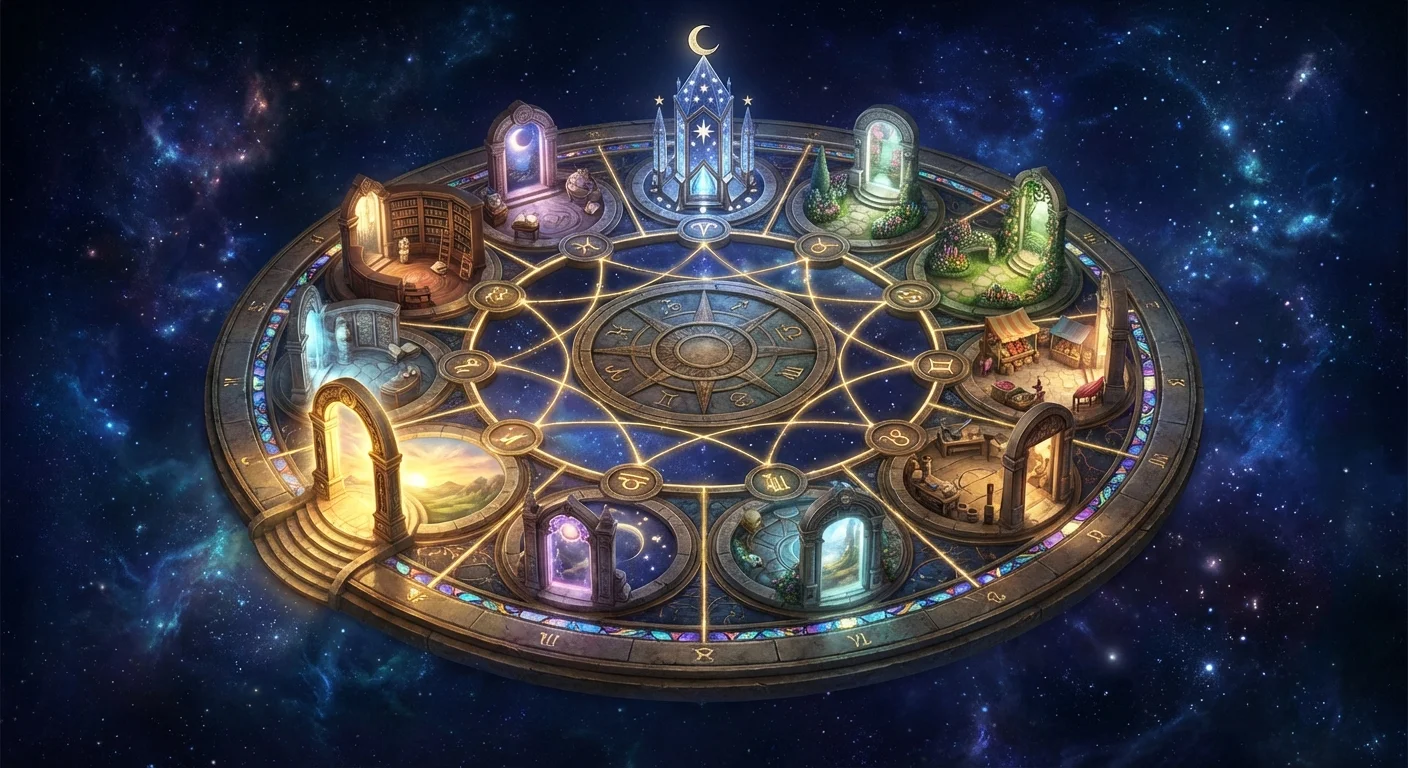
Understanding House Types
Angular Houses
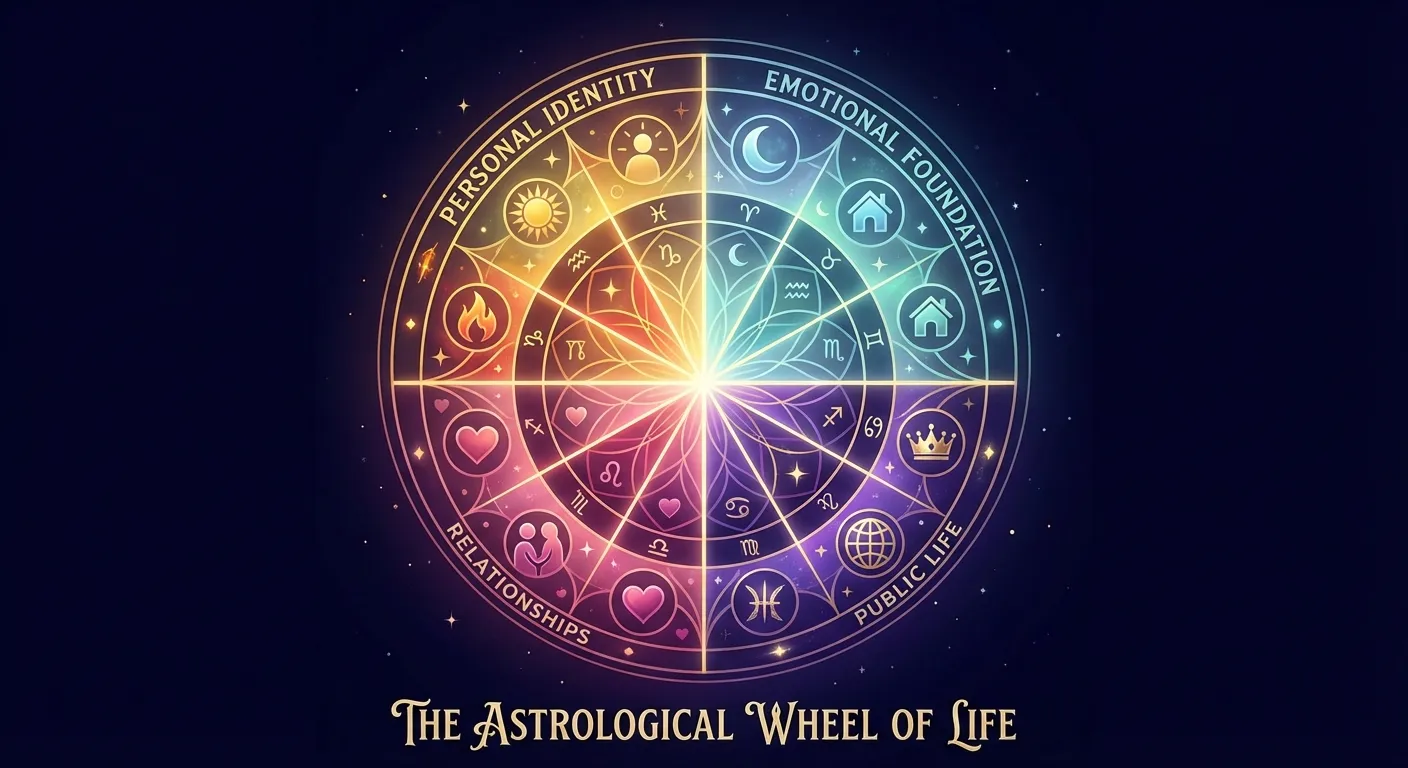
Houses 1, 4, 7, 10
Identity and action—where you initiate and define yourself
Succedent Houses
Houses 2, 5, 8, 11
Resources and stability—where you consolidate and build
Cadent Houses
Houses 3, 6, 9, 12
Learning and transition—where you adapt and prepare
Houses 1-4: The Personal Foundation
Identity, values, communication, and roots
The first four houses form your personal foundation—who you are (1st), what you value (2nd), how you think and communicate (3rd), and where you come from (4th). These houses build from the Ascendant, your point of entry into life.
The First House
•House of SelfRuled by Aries / Mars
Identity • Appearance • First Impressions • Beginnings
The First House, marked by your Ascendant, represents your sense of self, physical body, and the mask you wear in the world. It's how you initiate action and approach new situations.
Jungian Perspective: This house corresponds to the persona in Jungian psychology—the face you show to the world. Understanding your First House helps integrate the gap between who you appear to be and who you truly are.
The Second House
•House of ValuesRuled by Taurus / Venus
Money • Possessions • Self-Worth • Resources
The Second House governs your relationship with material security, personal resources, and what you value. It reveals your earning potential and attitude toward possessions.
Jungian Perspective: This house reflects how you build a sense of inner security and self-worth. Shadow work here involves examining unhealthy attachments to material things or poverty consciousness.
The Third House
•House of CommunicationRuled by Gemini / Mercury
Mind • Siblings • Local Travel • Learning
The Third House rules communication, thinking patterns, and your immediate environment. It governs siblings, neighbors, short trips, and early education.
Jungian Perspective: This house represents your conscious mind and how you make sense of daily reality. It shows how you gather information and communicate your inner world to others.
The Fourth House
•House of HomeRuled by Cancer / Moon
Family • Roots • Ancestry • Inner Foundation
The Fourth House, at the base of your chart (IC), represents home, family, ancestry, and your psychological foundation. It's your private life and emotional roots.
Jungian Perspective: This is the realm of the personal unconscious and inherited psychological patterns. It represents the mother archetype, early childhood conditioning, and the inner sense of belonging.
Houses 5-8: Creation and Connection
Creativity, service, partnership, and transformation
The second quadrant extends outward from self to other. Here you create (5th), serve (6th), partner (7th), and merge deeply with others (8th). These succedent houses stabilize and consolidate the resources of life.
The Fifth House
•House of CreativityRuled by Leo / Sun
Joy • Romance • Children • Self-Expression
The Fifth House is your creative playground—romance, children, hobbies, and artistic expression. It's where you experience joy, take risks, and express your unique spark.
Jungian Perspective: This house represents the inner child and the capacity for play. It's where we access spontaneous creativity and learn to express ourselves authentically without self-censorship.
The Sixth House
•House of ServiceRuled by Virgo / Mercury
Health • Work • Routine • Improvement
The Sixth House governs daily routines, health, work, and service to others. It's about self-improvement, skill development, and the discipline of everyday life.
Jungian Perspective: This house relates to the process of refinement and purification. It's where we learn humility through service and develop practical skills that support our larger purpose.
The Seventh House
•House of PartnershipRuled by Libra / Venus
Marriage • Contracts • Open Enemies • The Other
The Seventh House, opposite your Ascendant, represents committed partnerships, marriage, business partners, and open adversaries. It shows what you seek in others.
Jungian Perspective: This is the house of projection—we attract partners who embody qualities we've disowned in ourselves. Understanding your Seventh House is key to integrating the Shadow through relationship.
The Eighth House
•House of TransformationRuled by Scorpio / Pluto
Death/Rebirth • Shared Resources • Intimacy • Occult
The Eighth House governs deep transformation, shared resources, inheritance, sexuality, and the occult. It's where we merge with others and confront the mysteries of existence.
Jungian Perspective: This is the realm of the collective unconscious and psychological death/rebirth. It represents the Shadow and the process of transforming destructive patterns into wisdom.
Houses 9-12: Expansion and Transcendence
Philosophy, achievement, community, and spirituality
The final quadrant moves beyond personal concerns into the collective and transpersonal. Here you seek meaning (9th), build a legacy (10th), connect with community (11th), and transcend the ego entirely (12th).
The Ninth House
•House of PhilosophyRuled by Sagittarius / Jupiter
Travel • Higher Education • Beliefs • Expansion
The Ninth House expands your horizons through foreign travel, higher education, philosophy, and spiritual seeking. It's your quest for meaning and truth.
Jungian Perspective: This house represents the religious function of the psyche—the drive to find meaning beyond the mundane. It's where we develop our personal mythology and ethical framework.
The Tenth House
•House of CareerRuled by Capricorn / Saturn
Reputation • Achievement • Authority • Public Life
The Tenth House, at the top of your chart (MC), represents your career, public reputation, achievements, and relationship with authority. It's your contribution to the world.
Jungian Perspective: This house represents the father archetype and your relationship with authority figures. It shows how you've internalized social expectations and your path to authentic achievement.
The Eleventh House
•House of CommunityRuled by Aquarius / Uranus
Friends • Groups • Hopes • Humanitarian Vision
The Eleventh House governs friendships, group associations, social causes, and your hopes for the future. It's where you connect with like-minded others.
Jungian Perspective: This house represents the collective dimension of self—how we belong to groups and movements larger than ourselves. It shows our capacity to envision and work toward a better future.
The Twelfth House
•House of the UnconsciousRuled by Pisces / Neptune
Dreams • Solitude • Karma • Transcendence
The Twelfth House is the realm of the unconscious, hidden strengths and weaknesses, dreams, and spiritual transcendence. It's where the ego dissolves into something greater.
Jungian Perspective: This is the deepest layer of the psyche—the collective unconscious and the Self. It represents karma, past life patterns, and the process of ego transcendence and spiritual awakening.
Empty Houses: What They Mean
When no planets occupy a house
Not a Void
Having no planets in a house doesn't mean that life area is empty or unimportant. With only 10 planets (plus nodes) to fill 12 houses, most people have several empty houses.
Empty houses simply operate more automatically—they don't demand the same conscious attention as houses with planetary placements.
How to Interpret
To understand an empty house, look at:
- •The sign on the cusp — This colors how you approach that life area
- •The ruling planet — Its placement by sign and house shows where this life area connects
- •Transiting planets — When planets transit an empty house, that area temporarily comes alive
Frequently Asked Questions
What does it mean if I have no planets in a house?▼
What is the difference between houses and signs?▼
What are angular, succedent, and cadent houses?▼
Why does house size vary in my chart?▼
What is a house cusp?▼
What is the IC and MC?▼
See Your House Placements
Create your free natal chart and discover which planets occupy your houses and what that means for your life.
Calculate Your Free Chart→